
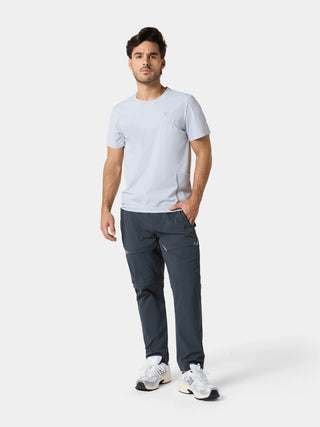
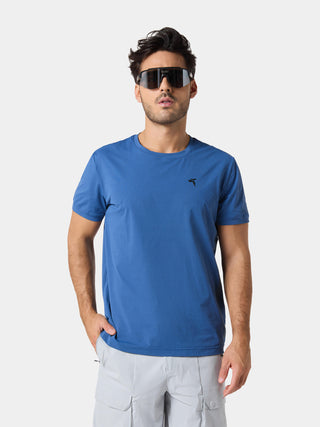
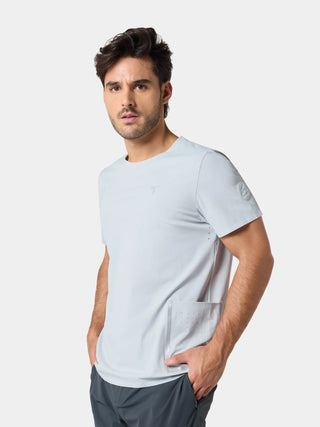
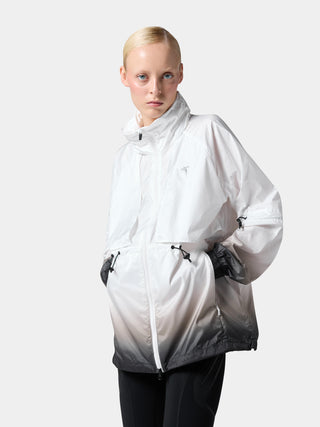
There is a Shanghai woman, late twenties, on a Wednesday in October. She has a meeting at ten, the kind of meeting that asks her to be composed without performing composure. She has not slept well. There is a thirty-minute walk between her apartment and the office, and she has just decided to take it on foot rather than the metro. She wants the morning. She wants to feel the air on her face. She wants to be in motion before the day asks her to be still in a chair.
What she is wearing does not stop her from being how she wanted to be. The garment moves with her shoulder when she pulls open the heavy door. It accommodates the small bag she has slung across her chest. It gives shape to her line without insisting on a line. By the time she sits down at ten, the garment has done its work. She is in the room, composed, ready, and recognizably herself.
This, in plain prose, is what FENGGY makes. And the woman in Shanghai is the question Ge Feng has been answering for seven years.

A designer brand in Shanghai.
FENGGY was founded on 18 March 2019, in Shanghai, by the designer Ge Feng (葛凤).
She holds a master's from The Hong Kong Polytechnic University and a bachelor's from Zhejiang Sci-Tech University, and she spent 2011 to 2018 as design director at DECOSTER and at the Nong Ying label of Jiangsu Hua Yi Group before she put her own name on a brand. That brand was built on a cutting method. Each season carries its own theme; the method underneath stays the same.

FENGGY's work is not in its marketing. It is in the method.
立裁: the methodology.
The brand's methodology has a name: 立裁 (lì cái), which the brand's own English renders as Vertical Cutting, and which, in plain English, is draping. It is one of the older traditions of garment making, carried through couture in Paris and New York and through several decades of Japanese craft.
What distinguishes 立裁 from pattern-first design is the sequence. In pattern-first design, the cut is drawn on paper, then cut into cloth. In 立裁, the cut is shaped on the form: the cloth is hung, pinned, draped and adjusted, and the paper pattern follows the resolved line rather than setting it. FENGGY's own construction notes repeat the same phrase, piece after piece: 立裁板型设计, a draped pattern that follows the curve of the body.

The result, when it is done well, is a garment whose line follows the line the body would have followed if no one had told it otherwise. There is no fight between cloth and body. The garment gives shape to how the body wanted to be.
The method asks more of the designer: someone who can see the body in the cloth before the cloth has fully decided what it is. FENGGY has worked this way since 2019, and the method is still named on the brand page of every lookbook from 2024 autumn and winter through the 2026 spring and summer books.
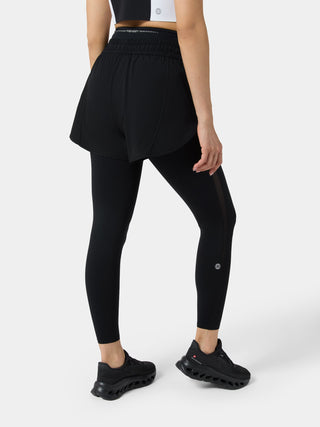
What makes it suited to athleisure is where it starts. The cut is shaped on the form and fitted to the structure of the body before a pattern exists. FENGGY's notes on a yoga pant read: draped pattern design, fitted to the body's structure, free stretch without tightness, lighter in movement. When the garment then meets a wearer who is moving through a city, the cut does not have to be retrofitted. It was made for that.
Natural Origin.
In April 2024, at Shenzhen Fashion Week, FENGGY presented its 2024 A/W collection. The collection was called NATURAL ORIGIN. The brand's own statement, in its own words:
Under the fast-paced life, people pursue something more faithful to the perception of life. Urban beauties urgently need a new lifestyle to relax their bodies and minds for a short time…

Three seasons have followed the 2024 A/W collection, through to Lumen Hunter for 2026 spring and summer, and each returns to the same question. NATURAL ORIGIN states it most plainly. The fast-paced life is the condition the audience lives inside. The pursuit of something more faithful to the perception of life is the recognition that what has been on offer (the standard luxury silhouette, the standard athleisure trope, the standard styled-for-the-photograph register) is not faithful to the way the body actually moves through the actual day.
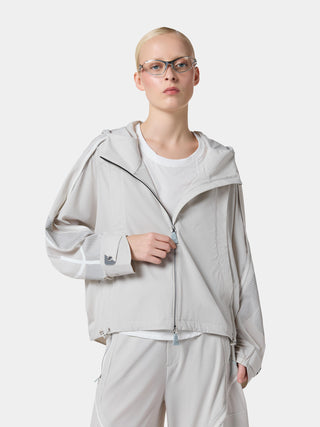
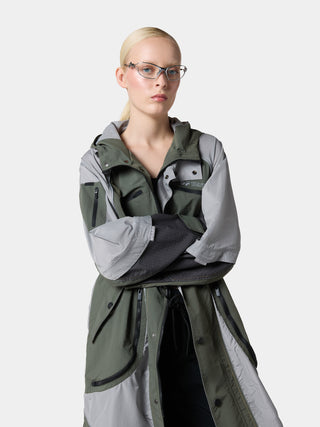
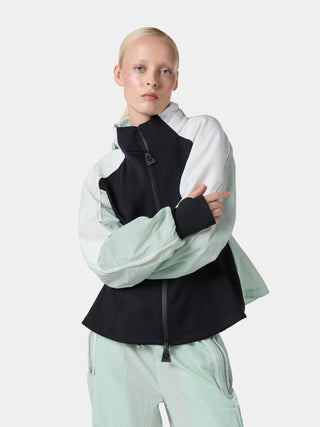
NATURAL ORIGIN, as a collection, answers the condition through fabric, through silhouette, through detachable construction (a FENGGY signature: pieces that can be worn multiple ways, that integrate clothing and accessory, that change function as the day changes), and through color. The brand describes the season's colors as drawn from nature, softer and lower in key. The lookbook sets them out across ninety-four looks in five color families: cyan, army green, black and white, pink, and orange. Pink and orange run from look 65 to look 79.
But the deeper answer, behind the collection, is the methodology. NATURAL ORIGIN is what 立裁 produces when 立裁 takes the contemporary urban woman as its subject. The line follows what she wanted. The cut earns its place by being where she is, not where the catalog says she should be.
Beyond athleisure.
In August 2024, Ge Feng gave a keynote at the Sanmen Jacket Industry Forum, the jacket industry's own gathering, held in Shanghai under the guidance of the China National Garment Association and hosted by Zhejiang Sci-Tech University and the Sanmen jacket industry association. Her title was 《时尚创新力量在户外原创品牌的可持续发展》: the power of fashion innovation in the sustainable development of original outdoor brands. The sustainability work sits on the garments. FENGGY states that it uses recycled fabrics, biodegradable fibers and a low-carbon supply chain, and the construction notes for its waist-drawcord trench name the fabric as an eco fabric. The 2024 A/W collection carried a look presented under its own heading, SUSTAINABLE JACKET: a detachable jacket worn with cargo pants.
The dimension FENGGY brings.
NeoSpherium hosts FENGGY because what FENGGY makes is part of what the audience deserves. A garment built for the body that is actually moving meets the audience exactly where they live: a Shanghai street, a Kuwait corridor, a Riyadh boardroom, a London afternoon.

Our other District, TITTALLON, is minimalist all-season performance outerwear, the city and the trail held in one garment. FENGGY brings the body honored at speed. Different poles. One NeoSpherium. Both built by people who knew the question before the question got asked.
What the line knows.
FENGGY's catalog carries a phrase that, in lesser hands, would be a marketing line. In FENGGY's, it is something nearer the truth:
Urban beauties urgently need a new lifestyle to relax their bodies and minds for a short time.
The relax is not the relax of holiday. It is the relax of being in your own body again, in your own day, in clothing that lets you be how you wanted to be.
The line the body wanted to follow is the line FENGGY has been finding since March 2019. The discipline is the methodology. The methodology is the work. The work, as it should, makes the wearing invisible.
This is the dimension FENGGY has brought to NeoSpherium. And the dimension we intend to honor.
Enter FENGGY within NeoSpherium.