
There is a particular kind of luxury that reveals itself slowly: the luxury of a garment that does more than one thing. Not through gimmickry, not the add-on that never quite sits right, not the reversible coat that looks compromised on both sides. Through genuine design intelligence, where a single piece becomes more than one garment, each state complete.
This is the promise of FENGGY’s Sustainable Jacket. It is the clearest expression yet of what FENGGY means when it says a garment should honor the body that is actually living the day.

One jacket, several lives.
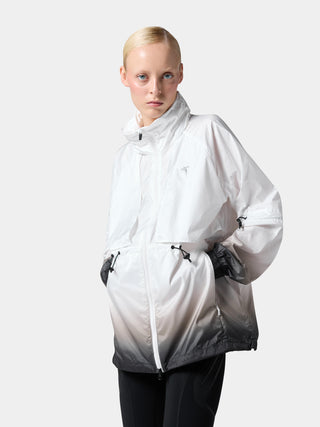
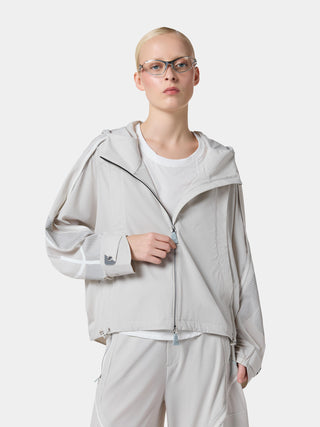
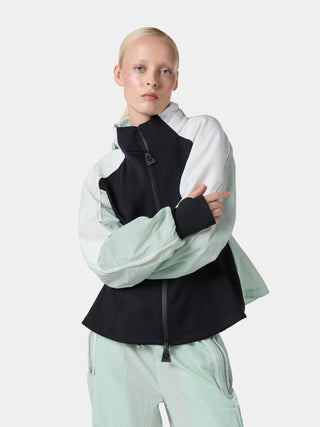
The Sustainable Jacket is built to come apart. Its sleeves detach, and the jacket becomes a vest. The two-tone panels part at the shoulder line: khaki body, cream sleeves, joined by exposed metal snaps. The parts recombine: jacket with sleeves, jacket without. FENGGY files the piece in its own lookbook under 一衣多穿, one garment worn many ways.
This is not new territory for FENGGY. The brand’s whole methodology of 立裁 (draping, which FENGGY’s own English calls “Vertical Cutting”), the line shaped to hold on the moving body, produces garments that already understand motion. The Sustainable Jacket extends that understanding into modularity: the garment adapts not only to the body’s movement but to the day’s changes, the year’s turn, the wearer’s shifting needs.
A woman puts on the full jacket at seven in the morning, when the air still carries the night’s cold. By midday the sleeves are off, and the vest alone carries her through a warm afternoon. The components do not announce their cleverness. They simply work.

The Sanmen conversation.
In August 2024, FENGGY’s founder Ge Feng was invited to speak at the Sanmen Outdoor Jacket Industry Forum, held on August 27 at the National Exhibition and Convention Center in Shanghai and convened around the Zhejiang Province county of Sanmen, which the forum’s poster bills as China’s famed city of outdoor-jacket making. The forum is where the industry’s questions about its own future get asked.
Ge Feng’s keynote was titled, in translation, “The Power of Fashion Innovation in the Sustainable Development of Original Outdoor Brands.” FENGGY is luxury athleisure for the modern woman, where performance meets couture, and Ge Feng was there to bring a designer’s eye to an industry question. The title carries the frame: fashion innovation put to work on sustainable development. The question it puts is whether sustainability is only a materials question, or a design question too. A garment that becomes many garments is a garment that resists the disposable logic of fast fashion. If one well-made piece can be worn several ways, the math of consumption changes.
Buy less. Buy better. Let the one garment do the work of several.
This is the deeper meaning of the Sustainable Jacket. Its modularity is more than a line on the spec sheet. It is a philosophy of consumption made wearable.
Vertical cutting meets sustainability.
What makes FENGGY’s approach distinct is that the second life is designed in, not bolted on.
Vertical cutting, 立裁, shapes the cloth to the body’s own structure. FENGGY’s garment notes return to the same phrase again and again: 符合人体工学结构, conforming to the ergonomics of the body. It is a method concerned with fit before anything else: the cut follows the form, so the line holds while the body moves. When Ge Feng extends this discipline to modularity, the result is a piece whose second life is built into the pattern rather than added to it.

Across the brand, FENGGY says it works with recycled fabrics, biodegradable fibers and a low-carbon supply chain. This jacket itself is cut in a three-proof nylon: windproof, rain-resistant, water-repellent. But its deeper sustainability is in its multiplicity: the way it refuses the premise that you need a different garment for every condition. One jacket. Several lives.
What this brings to NeoSpherium.
NeoSpherium hosts FENGGY because FENGGY asks the questions that matter, and answers them through the work rather than the marketing. The Sustainable Jacket is the proof: a garment that becomes many is a garment built for a wearer who is paying attention.

Our other District, TITTALLON, approaches the same question of regeneration from inside the performance-outerwear supply chain: its RECYCLED fabric, made from fiber recovered from plastic bottles and able to be recycled back into PET fiber. Read our companion piece, A Coat That Knows How to Come Back, for that register of the conversation. Different poles, hosted side by side in NeoSpherium. The same seriousness about what fashion owes the world it dresses.
What the many know.
A garment that becomes many is a garment that has thought about your life: not the photograph of your life, but the actual day, with its shifts in weather and need and intention.
The same jacket on a different morning is a different jacket. That is not a loss. That is the design.
This is the dimension FENGGY has brought to NeoSpherium, and the dimension we intend to honor.
Enter FENGGY within NeoSpherium.